Building Resilience in an Uncertain World
One of our core commitments as a school is to help students build resilience — not only academically, but socially and emotionally as well. In a world that feels increasingly fast‑paced, uncertain and digitally saturated, this work has never been more important.
Recently, I attended a workshop led by Dr Danielle Einstein, Clinical Psychologist and Adjunct Fellow at Macquarie University, whose research explores the interaction between mental health, uncertainty and device use. Dr Einstein is the author of The Einstein Report website and co‑author of Raising Anxiety, widely respected resources supporting schools and families to better understand how technology shapes young people’s emotional development and wellbeing.
A key message from the workshop was this:
Our ability to tolerate uncertainty is
fundamental to resilience.
When young people learn to trust their own capacity to manage uncertainty — to think on their feet, problem‑solve, plan and adapt — they are better equipped to face challenges both inside and outside the classroom. These skills are essential for academic learning, healthy relationships and long‑term wellbeing.

The Impact of the Digital Environment
Research shared by Dr Einstein highlights some concerning trends for young people today. Individuals with problematic social media use are more likely to experience social anxiety, and many adolescents report feelings of loneliness despite being constantly “connected” online. This speaks to what Dr Einstein describes as an emerging “anxiety economy”, where platforms are designed to capture attention by exploiting uncertainty, comparison and fear of missing out.
Importantly, Dr Einstein emphasised that education alone is not enough. Simply telling young people about the addictive nature of devices does not counter their powerful pull. Instead, a public‑health, multi‑layered approach is needed — one that includes clear boundaries, supportive policies, environmental changes and strong role‑modelling by adults. The introduction of the Australian Social Media Regulation in 2026 reflects this broader public‑health response, acknowledging that responsibility must be shared across families, schools, industry and government, rather than resting solely with young people.

What Resilience Looks Like in Practice
This approach aligns strongly with our work as a college. We know that resilience is built when students are supported to:
- manage uncertainty rather than avoid it
- develop internal confidence and self‑trust
- practise self‑regulation and self‑restraint
- build real‑world social skills and connection
As educators, we also recognise our responsibility to model healthy technology use, set clear expectations and create environments that support focus, learning and wellbeing. Schools play a crucial role in shaping norms — helping students understand that it is okay to be offline, to sit with discomfort, and to engage deeply with learning and with one another.
We also know that this work is most effective when schools and families work together. To support our community, we encourage families to access SchoolTV, which provides evidence‑based resources on anxiety, depression, digital wellbeing and resilience.

Partnering with Families
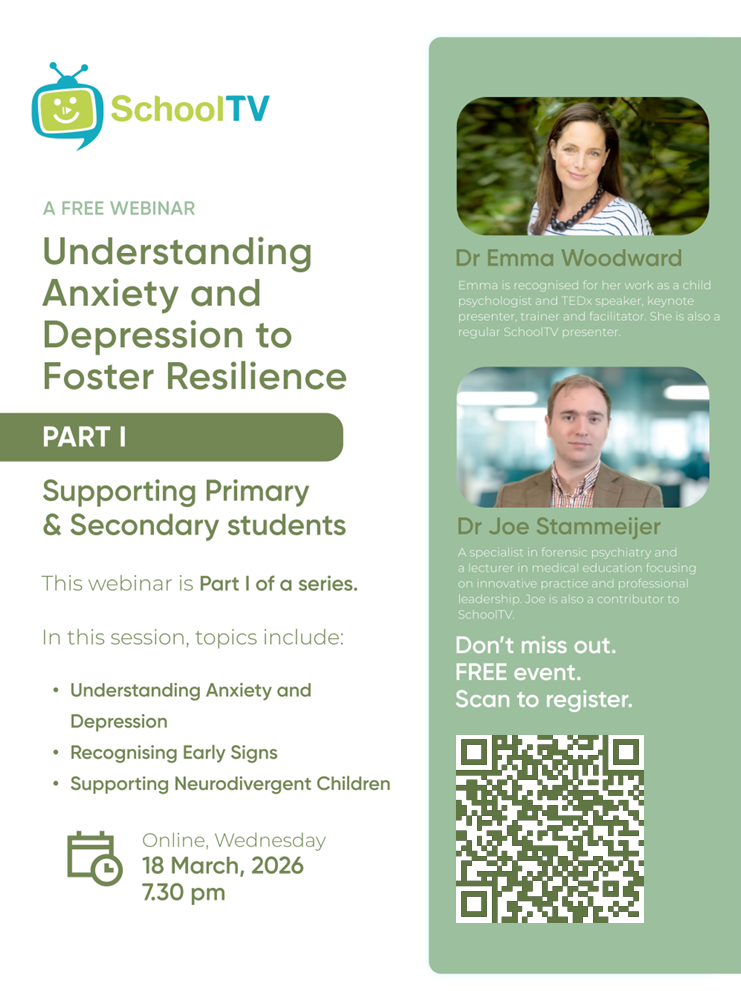
In addition, families are warmly invited to attend the upcoming webinar: Understanding Anxiety and Depression to Foster Resilience. This session will provide practical insights into how we can support young people to navigate uncertainty and build emotional strength. Register via SchoolTV here.
By working together — setting thoughtful boundaries, modelling healthy behaviours and equipping students with the skills to manage uncertainty — we can help our young people grow into confident, capable and resilient learners, ready to meet the challenges of an ever‑changing world.
“Do not be anxious about anything, but in every situation, by prayer and petition, with thanksgiving, present your requests to God. And the peace of God, which transcends all understanding, will guard your hearts and your minds in Christ Jesus.”
Philippians 4:6-7
God bless,
Mrs Naomi Wilkins
Principal