

Social Media Age Restrictions
How can you help your children be prepared and stay connected to the people and things they love?
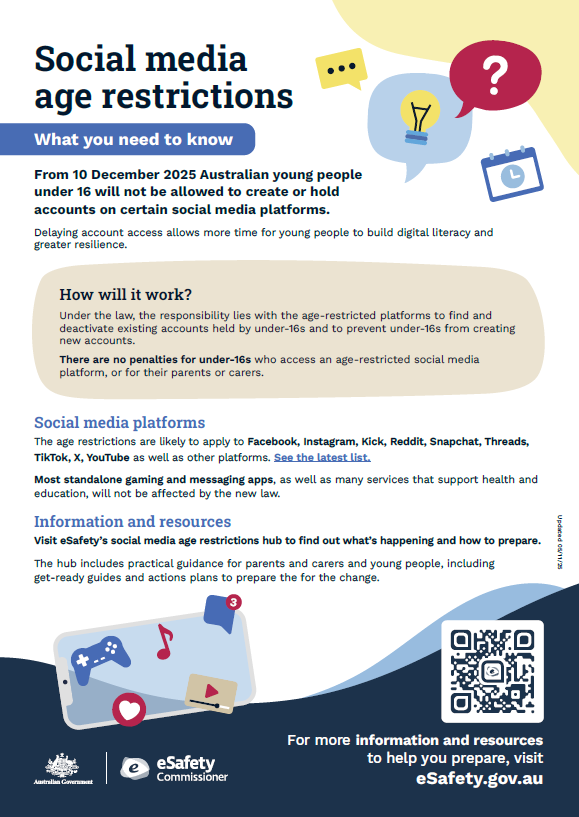
From 10 December 2025, many social media platforms won’t be allowed to let Australians under 16 create or keep an account. This is to protect them from design features that encourage them to spend too much time online and show them content that can be harmful to their health and wellbeing. The aim of delaying account access until 16 is to give young people more time to develop important digital, social, and emotional skills before facing the risks of age-restricted social media accounts.
Some quick facts:
- The age restrictions are likely to apply to Facebook, Instagram, Kick, Reddit, Snapchat, Threads, TikTok, X and YouTube, as well as other platforms.
- Under-16s will still be able to see publicly available social media content that doesn’t require logging into an account.
- Most standalone gaming and messaging apps, as well as many services that support health and education, will not be affected by the new law.
- The following social media platforms will not be aged-restricted; Discord, GitHub, Google classroom, LEGO play, Messenger, Roblox, Steam and Steam chat, WhatsApp, and YouTube kids.
- There are no penalties for under-16s who access an account on an age-restricted social media platform, or for their parents or carers. This is about making the platforms take greater responsibility for the safety of children as they face fines of up to $49.5 million dollars if they don’t take reasonable steps to implement the changes.
- Platforms are meant to remove accounts belonging to under-16s. Instead of removing accounts, some platforms may deactivate them so they can be reactivated with all their existing data when the user turns 16. However, users should not rely on platforms to provide this option. It’s best for under-16s to download any data they want to save, including connections, posts, chats, photos and videos, before 10 December.
It’s a big change and your child may be worried about losing access to their favourite people, content, and communities. But with some preparation, there are other ways you can encourage them to stay connected, express themselves, find out about things and have fun.
The link below is an 8-step guide provided by the esafety commission that will help you work through what you can do now to help your children to get ready for this change. I encourage you to use this and the action plan below to help navigate your discussions and organise a smoother transition to alternative social media platforms.
God bless,
Ms Alison Menzies
Deputy Head of Senior School – Health and Wellbeing